Choosing the right decoration method is paramount in the success of any custom clothing project, regardless of whether it’s a new line or an entire team. The right decoration method can make or break a custom apparel project, whether you are creating a new line or an entire team. DTF vs DTG Printing are two of the most prominent advances in digital print technology used in today’s clothing decoration.
Understanding Modern Apparel Printing
The wide range of benefits offered by digital textile printing – including quick turnarounds, small production runs and brilliant fabric colors – has revolutionised production of bespoke garments. Unlike standard screen printing, where each screen is created and setups, and requires hard mesh screens, digital methods are designed to transfer the high-resolution graphic files straight to wearable art.
With the increasing market for custom-made clothing, there are several aspects that will be crucial to consider: the detail of the image, the fabric your clothes are to be printed on, the feel of the printed surface and the durability of the wash. High-grade wholesale Custom Embroidery offer a soft, dense cotton surface to properly test and maximize print quality with every single batch for print shops.
What is DTG Printing?
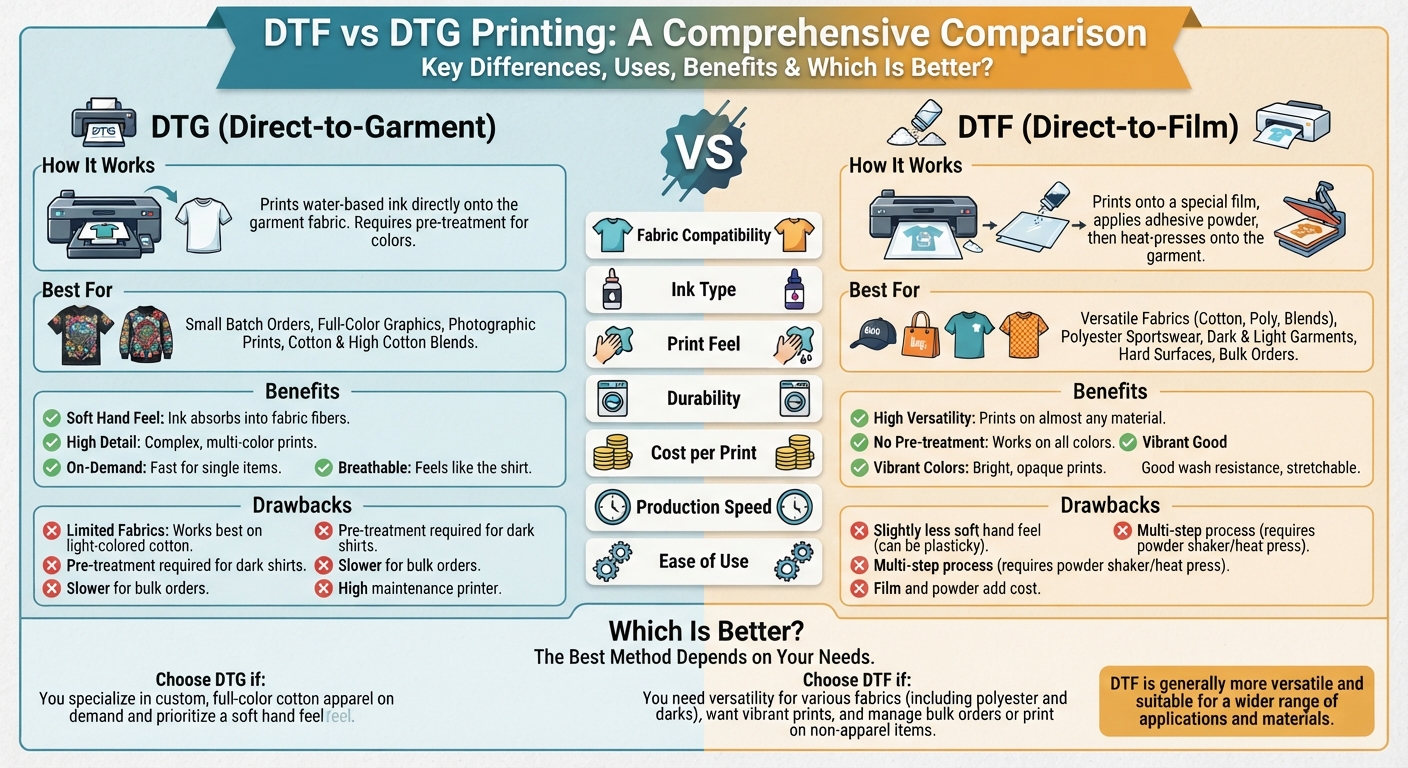
Direct-to-Garment printing works a lot like a regular desktop, inkjet-based printer designed for apparel decoration applications. The machine sprays a specially formulated liquid ink containing pigment that immediately impregnates the fibers and produces a cohesive, even and permanent print while keeping the printed color dark.
This method gives an unparalleled softness and breathability since the specially formulated ink penetrates deep into the fibers and doesn’t rest on the surface. This is particularly good on natural materials, especially 100% ring spun cotton, and is a favourite thus far among retail fashion brands and artistic tees.
What is DTF Printing?
Direct-to-Film printing is a flexible solution for 2-part printing. Instead of shooting the ink directly onto the garment, the print is placed on a transparent film using the special inks, and then a uniform layer of adhesive powder is applied with the hot-melt method over the print.
Heat-curing the adhesive powder to a flexible bonding layer, and then heat-pressing the adhesive to the blank garment. After peeling off, the graphic remains bright and lasting, and will not adhere to the surface with any problems on virtually any fabric.
Key Differences: DTF vs DTG Printing
Application of inks directly to the garment use water based inks which penetrate the natural cellulose garments, Direct-to-Film uses application of melted Thermoplastic Poly Urethane fibrillation with a cured film surface directly to the outside of garment target materials.
Creators benefit from the underlying chemistry that develops the set characteristics. The inks used in Direct-to-Garment do need special liquid pre-treatment on dark garments but the inks used in Direct-to-Film do not require any garment pre-treatment, with printed transfers being stored for as long as the operator wishes before being heat pressed onto goods for centuries.
Critical Factors in Apparel Printing Methods
- Due to the absorption of the water-based pigment inks into natural fibres, Direct-to-Garment printing gives an ultra-soft hand-feel.
- For dark synthetic fabrics, Direct-to-Film transfers deliver outstanding color intensity with a special dense white adhesive under the design.
- For low-profile dark or heavily dyed cotton prints, the white pigment inks need to be bonded to the garment with constant garment pre-treatment processes on direct-to-garment machinery.
- With Direct-to-Film technology, all types of fabric are compatible, so that crisp and reliable prints can be printed on polyester, nylon, canvas, spandex and blended textiles.
Print Quality, Hand-Feel, and Durability
Both techniques produce fine-grained, detailed designs, color gradations and photo realistic artwork. Direct-to-Film does work better on dark synthetic fabrics, though, since the white adhesive soaking base is placed on the transfer film, and not into the fiber of the garment, as in the loose base.
Direct-to-Garment has a soft, almost imperceptible hand-feel on light cotton types of garments, which lets the print go to the fabric layer beneath it. However, Direct-to-Film has a smoother, continuous film that provides outstanding flexibility, said to last for dozens of tough wash cycles.
Fabric Compatibility Across Different Apparel Types
When brand owners are considering expanding their product catalog, they must consider the roles of each print technology in unique textile blends. For the best results Direct-to-Garment printing is best suited for 100% natural fabrics such as cotton cellulose, which ample water-based ink is particularly delicious in. However, with heavy polyester, it is not quite necessary to use complex chemical barriers for the DTG inks to migrate or not hold.
With Direct-to-Film these traditional fabric limitations come easy. The DTF Printing glue is also powder form, serving as the adhesive property between the ink layer and the fabric, which can be fixed on 100% polyester and nylon windbreakers, stretchy spandex fabrics, heavy canvas tote bags, textured fleece and so on without fading, bleeding or reducing the strength of the fabric structure during long use.
Production Speed and Operational Workflow
Choosing the right decoration method depends upon matching your workflow’s requirements for set up time, material costs, or labor. Direct-to-Garment prints one garment at a time which is great for small order with several colors but for larger quantities of same colours printing it’s a bit slower.
Print shops can use the sturdiness of Iconic Stitches to accomplish efficient out-of-the-way Direct-to-Film transfers which maintain their sharpness on textured knits such as those in athletic apparel and corporate uniforms. When there are downtimes, film transfers can be preprinted and transferred to inventory as orders come in.
Equipment Maintenance and Setup Requirements
Running a thriving digital print shop requires a focus on everyday practices and maintenance of the equipment. DTG printers use a water-based ink and have a very small print head that can get clogged up if the workspace is humid or if the machine isn’t used for a long period without it being cleaned.
Direct-to-Film systems too demand regular maintenance, but the process of printing is separated from the production of textiles. The isolation lessens the amount of lint in the printer, but it’s essential for the operator to control the powder-use section to assure clean curing and to maintain a safe, dust-free working shop.
Core Advantages of Digital Print Technologies
- As D2G printers use non-toxic water-based pigment inks, it’s an eco-friendly solution that eliminates carrier films as printer waste.
- Unlike traditional methods of printing transfer sheets for film, a business can pre-print new transfer sheets for use as needed, when it receives new orders from customers.
- DTG is best used for creating beautiful, fine hues and detailed photos on light-colored, natural cotton fabric surfaces.
- High elastic 3D printing, with the help of direct-to-film adhesive powder, enables tearing prints perfectly without crack to achieve more than just stamina, it also provides performance activewear and athletic clothing with more flexibility.
Cost Analysis and Initial Investment Factors
Understanding the financial commitment involved with each printing method helps business owners make smart capital investment decisions. Direct-to-Garment setups generally carry higher initial equipment costs for commercial-grade machinery and require ongoing investments in specialized liquid pre-treatment solutions to prepare dark cotton apparel for white ink bases.
One of the benefits of direct-to-Film is that while much of the infrastructure is expensive, it can often be obtained at a lower cost. But the costs of particular PET carrier film, TPU adhesive powders and heat-curing ovens must be determined for continued use by the shop owner. These one-time hardware investments can be weighed against on-going hardware consumption costs to calculate long-term profitability per printed unit.
Choosing the Right Method for Your Business
Deciding between these two dominant digital methods depends heavily upon your product offerings, artwork complexity and customer expectations regarding physical feel. Direct-to-Garment may make sense for businesses specializing in 100% cotton apparel or vintage style artwork that prioritize breathability over other qualities such as luxurious fashion lines or vintage art reproduction.
Direct-to-Film is ideal if your primary garment catalog consists of polyester activewear, blended outerwear, hats or dark synthetic fabrics that require high contrast and stretch resistance. Matching equipment investments to core garment catalogs prevents costly bottlenecks while guaranteeing consistent output quality.
Why Quality Blanks Matter for Any Print Method
No print technology can overcome an inferior base garment. Smooth and high-grade fabrics are key for proper ink adhesion, vibrant color payoff, and lasting washability – garments sourced must feature consistent weaves, low surface fuzz levels, durable stitching techniques to withstand professional heat presses as well as regular laundry cycles.
Partnering with Iconic Stitches ensures access to top-tier blank garments built specifically for custom decoration. Known across the USA for premium wholesale clothing, We also provide professional custom decoration services, including screen printing and detailed embroidery to meet every branding need.
The End Note!
Examining DTF vs DTG printing depends on balancing fabric options, print texture, production needs and production volume. DTG provides exceptional softness on cotton garments while DTF offers vibrant colors with lasting wear across varying materials. When starting with quality blanks for both processes, every custom design looks stunning while lasting throughout its lifespan.