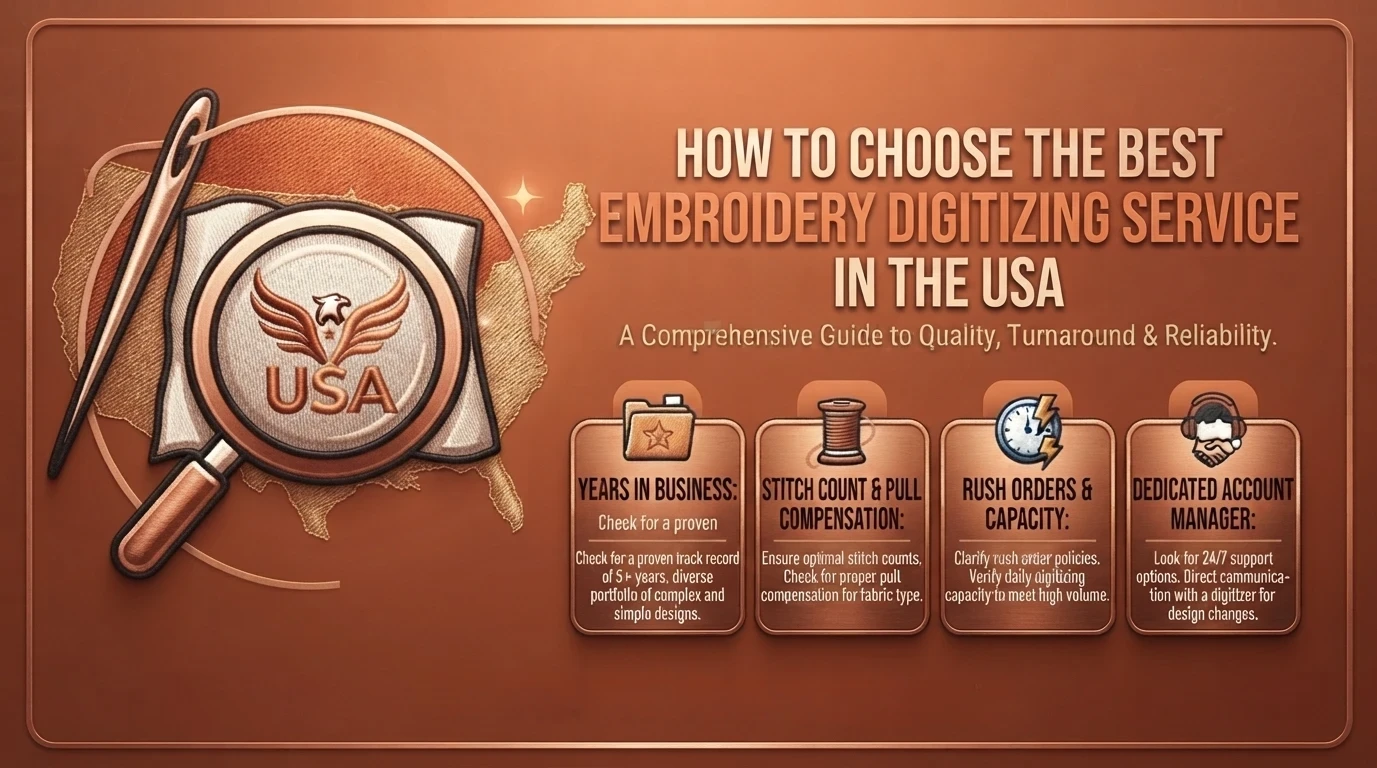
Choosing the right Embroidery Digitizing Service USA can make a major difference in the final quality of embroidered logos, patches, hats, jackets, uniforms, and other apparel. A well-digitized design does more than convert an image into an embroidery file. It determines how stitches are placed, how colors interact, how details appear, and how efficiently the design runs on an embroidery machine.
Whether you own an embroidery business, manage an apparel brand, create promotional products, or need a custom logo embroidered, selecting an experienced digitizing provider is an important decision.
With so many options available, including low-cost providers, automated software, freelancers, and professional digitizing companies, it can be difficult to know which service offers the right combination of quality, reliability, pricing, and customer support.
This guide explains what to look for when choosing a professional embroidery digitizing company in the USA and how to determine whether a provider can deliver embroidery-ready files that work for your specific project.
What Is Embroidery Digitizing?
Embroidery digitizing is the process of converting artwork, logos, text, or other graphics into a digital embroidery file that an embroidery machine can understand.
A normal JPG, PNG, PDF, or vector image cannot simply be sent directly to an embroidery machine. The artwork must first be converted into a stitch-based design.
A professional digitizer determines:
- Stitch types
- Stitch direction
- Stitch density
- Underlay
- Thread sequence
- Color changes
- Pull compensation
- Stitch length
- Fabric considerations
- Design size
- Registration
- Machine compatibility
This process is commonly referred to as digitizing embroidery or digitizing for embroidery.
The goal is not simply to create a file. The goal is to create a design that produces a clean and professional result when embroidered onto the intended material.
Why Professional Embroidery Digitizing Matters
Two embroidery files created from the same artwork can produce completely different results.
One may look clean, balanced, and professional, while another may have:
- Uneven stitching
- Excessive thread density
- Poor registration
- Gaps between colors
- Small details that disappear
- Thread breaks
- Fabric puckering
- Unnecessary stitches
This is why choosing one of the best embroidery digitizers is important, particularly for commercial embroidery.
Professional digitizing considers the relationship between the artwork, embroidery machine, thread, garment, and final design size.
For example, a logo intended for a structured cap may require different digitizing techniques than the same logo embroidered on a jacket or polo shirt.
Things to Consider When Choosing an Embroidery Digitizing Service
Check the Quality of Previous Work
Before selecting a provider, review its portfolio.
Look for examples involving different types of embroidery, including:
- Logos
- Caps
- Hats
- Jackets
- Shirts
- Uniforms
- Patches
- Small lettering
- 3D puff designs
- Applique designs
A good portfolio should demonstrate consistency rather than only showing a few attractive designs.
Pay particular attention to small details, curved lettering, outlines, gradients, and areas where multiple colors meet.
If a company has experience with different fabrics and garment types, it is generally better positioned to handle customized projects.
Choose a Service With Experience in Your Product Type
Not every embroidery project requires the same digitizing approach.
For example, cap logo embroidery requires consideration of the curved surface of a hat. A jacket-back design may need different density and stitch strategies because of its larger size.
Similarly, hat embroidery digitizing USA projects may involve structured caps, five-panel caps, snapbacks, beanies, or other headwear.
If you regularly produce hats, look for a hat digitizing company that understands:
- Cap construction
- Center alignment
- Curved sewing areas
- Underlay requirements
- Stitch direction
- 3D puff applications
For jacket projects, look for experience with embroidery digitizing for jackets, especially large back designs.
Make Sure They Offer Custom Embroidery Digitizing
Automated conversion can be useful for simple graphics, but professional projects often require human adjustments.
Custom embroidery digitizing allows the digitizer to make decisions based on the specific artwork and application.
A professional custom digitizing embroidery service in USA should consider the final embroidery location and material rather than treating every image in exactly the same way.
For example:
A detailed logo embroidered at 10 inches wide on a jacket will require a different approach from the same logo reduced to 2.5 inches for a cap.
This is one reason professional digitizing can outperform simple auto digitizing embroidery software free solutions.
Check Available Embroidery File Formats
Different embroidery machines may require different file formats.
Common embroidery formats include:
- DST
- PES
- EXP
- JEF
- VP3
- XXX
- HUS
- EMB
The DST file format embroidery is particularly common in commercial embroidery environments, while other formats may be required by specific machine brands.
Before ordering, ask the digitizer which file format you need.
A professional provider should be able to explain the difference between embroidery machine formats and supply the appropriate file.
If you are unsure about your machine’s requirements, provide the machine brand and model to the digitizing company.
Consider Turnaround Time
Turnaround time is especially important for embroidery businesses handling customer orders.
A cheap service is not necessarily valuable if it consistently misses deadlines.
Ask about:
- Standard turnaround
- Rush orders
- Revision policy
- Weekend or holiday processing
- Communication during production
- File delivery method
If you operate a commercial embroidery shop, predictable turnaround can be more valuable than choosing the lowest possible price.
Compare Pricing Carefully
Pricing varies depending on the complexity of the design.
A simple logo with limited colors may require less work than a detailed jacket-back design with thousands of stitches.
Factors that can influence pricing include:
- Design complexity
- Number of stitches
- Design dimensions
- Number of colors
- 3D puff requirements
- Applique
- Special effects
- Number of revisions
- Rush turnaround
You may find services advertised as cheap embroidery digitizing, including extremely low-cost offers such as “$5 digitizing.”
However, price should not be the only factor.
The cheapest file can become expensive if it causes thread breaks, poor embroidery quality, wasted garments, or production delays.
Instead of asking only, “How much does digitizing cost?” ask:
“Will this file produce the quality I need?”
Cap and Hat Embroidery Digitizing
Caps are among the most popular products for embroidered logos.
However, digitizing for hats requires specialized knowledge because the embroidery area is curved and often limited.
A professional cap embroidery service should understand how to prepare designs for different types of headwear.
Common projects include:
- Baseball caps
- Snapback caps
- Trucker hats
- Five-panel caps
- Structured caps
- Beanies
- Sports caps
For example, 3D puff embroidery digitizing uses foam underneath selected areas to create a raised appearance.
This technique is particularly popular for:
- Sports logos
- Brand names
- Monograms
- Large lettering
- Streetwear designs
Not every logo is suitable for 3D puff. Small details and thin lettering may require a traditional flat embroidery approach.
3D Puff vs. Flat Embroidery
Understanding the difference between these techniques can help you choose the right service.
Flat Embroidery
Flat embroidery uses stitches directly on the garment or fabric.
It works well for:
- Detailed logos
- Small designs
- Fine lettering
- Shirts
- Jackets
- Uniforms
- Patches
3D Puff Embroidery
3D puff uses foam beneath the stitches to create a raised effect.
It works particularly well for:
- Caps
- Bold lettering
- Sports logos
- Large shapes
A professional digitizer can determine whether 3D puff embroidery is appropriate for your artwork.
You can also explore Iconic Stitches’ dedicated 3D Puff Logo Digitizing Service when your design requires a raised embroidery effect.
Patch Digitizing and Embroidery
Patches are another area where specialized digitizing can improve results.
Depending on your project, you may need:
- Embroidered patches
- Biker patches
- Chenille patches
- Bullion patches
- PVC patches
- Custom logo patches
Each patch style can have different production requirements.
For example, Patch Digitizing focuses on preparing artwork specifically for embroidery patch production.
If you are looking for finished patch solutions, you can also explore Patch Services.
For specialized projects, Iconic Stitches also provides Biker Patches, Bullion Patches, Chenille Patches, Embroidered Patches, and PVC Patches.
Vector Artwork and Embroidery Digitizing
Sometimes the artwork supplied for an embroidery project is not suitable for digitizing.
For example, you may have:
- Low-resolution JPG
- Blurry PNG
- Screenshot
- Poor-quality logo
- Image with background
- Complex artwork
In these situations, vector artwork can provide a cleaner foundation.
Vector graphics can be scaled without losing their basic visual quality, making them useful for logos and branding projects.
If your artwork needs to be converted or cleaned before embroidery digitizing, consider a professional Vector Art Service.
This can be particularly useful when the original artwork is too low-quality for accurate digitizing.
Can AI or Software Replace a Professional Digitizer?
AI embroidery software and automated digitizing tools have become increasingly accessible.
Some programs can automatically convert artwork into embroidery stitches.
These tools can be useful for:
- Simple designs
- Basic experimentation
- Learning
- Personal projects
- Initial concepts
However, automatic conversion does not always understand the practical requirements of embroidery.
A machine does not embroider pixels. It sews stitches into fabric.
That means someone may need to adjust the automatically generated design for:
- Stitch density
- Underlay
- Pull compensation
- Stitch direction
- Small details
- Fabric type
- Registration
- Thread sequence
For commercial work, professional human review can therefore remain valuable even when AI or automated software is involved.
What Makes a Good Embroidery Digitizing File?
A quality embroidery file should be designed around the intended production requirements.
Important characteristics include:
Appropriate Stitch Density
Too many stitches can cause unnecessary thread usage, stiffness, or fabric problems.
Too few stitches can result in poor coverage.
Proper Underlay
Underlay helps stabilize the fabric and create a foundation for the top stitches.
Correct Stitch Direction
Stitch direction can influence the visual appearance of shapes and lettering.
Good Registration
Different sections of a design should align correctly when embroidered.
Appropriate Pull Compensation
Fabric can move or pull during embroidery. Professional digitizing accounts for these effects.
Efficient Stitching
A well-built file can reduce unnecessary movement and thread changes, improving production efficiency.
Ask for a Test or Review Process
If possible, work with a provider that has a clear review and revision process.
Before ordering a large batch, consider testing the design on the intended garment.
This is particularly important for:
- Large orders
- Corporate uniforms
- Sports apparel
- Caps
- Jacket backs
- Detailed logos
- Small lettering
A digital preview can show how the design is expected to look, but actual stitching provides the best indication of production performance.
Why Customer Support Matters
Communication is often overlooked when choosing an embroidery digitizer.
A reliable provider should make it easy to communicate details such as:
- Desired dimensions
- Garment type
- Thread colors
- Placement
- Machine format
- Stitching technique
- Special requirements
- Revision requests
For example, if you need the same logo digitized for a cap, shirt, and jacket, the digitizer should understand that one file may not be ideal for every application.
You may need separate versions optimized for each garment.
When Should You Choose a USA-Based Digitizing Service?
Businesses searching for an embroidery digitizing service in USA may prefer providers that understand the needs of the American apparel, promotional products, uniform, and embroidery markets.
A USA-focused service can be particularly useful when your customers require:
- Fast communication
- Consistent production
- Business-to-business support
- Commercial embroidery files
- Custom logos
- Bulk projects
- Apparel branding
- Patch production
However, the location of a provider should not be your only selection criterion. Quality, experience, portfolio, communication, file compatibility, and customer service should also be considered.
Wholesale and Bulk Embroidery Digitizing
Businesses handling large numbers of designs may need wholesale embroidery digitizing or bulk embroidery digitizing.
For example, an apparel company might need dozens of logos for:
- Different customers
- Multiple clothing collections
- Sports teams
- Corporate uniforms
- Promotional campaigns
- Retail products
In these situations, consistency becomes extremely important.
A professional digitizer should maintain consistent quality across multiple files rather than treating every order as an unrelated project.
For larger businesses, ask about volume pricing, turnaround, revisions, file organization, and long-term support before starting a large project.
Questions to Ask Before Hiring an Embroidery Digitizer
Before choosing a provider, ask these questions:
Do you provide custom digitizing?
Custom work is important when your artwork has unique requirements.
Which file formats do you provide?
Confirm that the provider supports the format required by your embroidery machine.
Can you digitize hats and caps?
If headwear is part of your business, verify their experience with curved embroidery areas.
Do you offer 3D puff digitizing?
Ask if you need raised embroidery for caps or other garments.
Can you handle large jacket-back designs?
Large designs require different considerations than small chest logos.
Do you offer revisions?
Find out how revisions are handled if the first version requires changes.
Can you work with low-resolution artwork?
If your logo is not available in a high-quality format, ask whether artwork cleanup or vectorization is available.
What is the turnaround time?
Make sure the expected delivery fits your production schedule.
Red Flags to Avoi
Not every embroidery digitizing provider offers the same level of quality.
Be cautious if a provider:
- Has no portfolio
- Cannot explain file formats
- Promises every design can be automatically digitized
- Offers extremely low prices without explaining the process
- Does not discuss fabric or garment type
- Refuses reasonable revisions
- Has unclear communication
- Provides only a file without explaining compatibility
- Makes unrealistic quality guarantees
Low pricing is not automatically a problem, but a combination of very low pricing + poor communication + no portfolio + no revision policy should make you investigate further.
Why Iconic Stitches Can Be a Useful Choice
Iconic Stitches provides professional embroidery-related services for businesses, brands, embroidery shops, and apparel projects.
Its services include:
- Embroidery digitizing
- Custom logo digitizing
- Patch digitizing
- Hat and cap digitizing
- 3D puff digitizing
- Vector artwork
- Custom patches
If you need a general Embroidery Digitizing Service, you can submit your artwork and discuss the requirements for your project.
For a professional digitizing workflow, the most important step is to provide accurate information about the final application. Tell the digitizer where the design will be embroidered, the approximate size, the garment or material, and the embroidery machine format you need.
This allows the design to be prepared according to its actual production purpose rather than simply converted from an image.
Final Checklist for Choosing the Best Embroidery Digitizing Service US
Before placing your order, review this checklist:
✔ Portfolio: Does the provider show quality embroidery examples?
✔ Experience: Do they work with your garment and design type?
✔ Customization: Can they manually optimize your artwork?
✔ File Formats: Can they provide the format your machine requires?
✔ Quality: Do they understand density, underlay, registration, and stitch direction?
✔ Hats: Can they handle cap and hat embroidery if required?
✔ 3D Puff: Do they understand foam-based embroidery?
✔ Patches: Can they prepare files for your required patch style?
✔ Revisions: Is there a clear revision policy?
✔ Turnaround: Can they meet your production deadlines?
✔ Communication: Can you easily explain your requirements?
✔ Pricing: Does the price make sense for the quality and service provided?
✔ Support: Will they help if you encounter a production issue?
Conclusion
Choosing the right Embroidery Digitizing Service USA is about more than finding the cheapest provider. The quality of the digitized file directly influences how your logo, artwork, lettering, or patch looks when it is stitched onto a product.
Look for a provider with a strong portfolio, custom digitizing experience, knowledge of embroidery file formats, reliable turnaround times, clear communication, and experience with the specific products you produce.
Whether you need a simple logo, cap embroidery, 3D puff design, jacket-back artwork, or custom patch digitizing, the right approach is to evaluate the service based on quality, technical knowledge, consistency, and customer support.
For businesses that depend on professional embroidery, investing in properly prepared files can help reduce production problems and produce more consistent finished products. A reliable digitizer can become more than a one-time service provider—it can become a valuable part of your embroidery and apparel production workflow. GET FREE QUOTE