Iconic stitches: A patch looks simple. But anyone who has ordered a batch that frayed after three washes, faded in the sun, or showed up with the wrong logo color knows the stakes are real. Your patch carries your brand, team, or event on every jacket, cap, and uniform it touches.
When you invest in high-quality custom patches, you’re paying for more than thread and fabric. You’re paying for durability through daily wear, a crisp look that matches your brand, a vendor who delivers on time, and a return on investment that lasts for years instead of months.
This guide shows you how to judge patch quality the way experienced buyers do. You’ll learn what to inspect, how patch types compare, which styles suit your industry, and how to tell a dependable US vendor from one that will cost you time and money.
What Separates High-Quality Custom Patches from Cheap Ones
Two patches can look similar in a product photo and perform very differently in real life. The gap usually comes down to a few things:
- Material grade: Twill, thread, PVC, and leather all come in good and poor versions.
- Construction: Stitch density, underlay, and border finishing decide how long a patch holds its shape.
- Attachment method: The wrong backing can make even a well-made patch fail early.
- Process control: Good vendors test samples, match colors, and inspect before shipping.
Premium custom patches don’t have to be the most expensive option. They’re the patches built correctly for how you’ll use them.
How to Evaluate Patch Quality: 6 Key Factors
1. Base Materials
Start with what the patch is made of.
- Twill: The standard base for embroidery patches. Look for a tight weave that doesn’t stretch or pucker.
- Felt: Softer and more vintage-looking, but less durable for heavy use.
- Thread: Polyester thread holds color well and handles bleach and frequent washing. Rayon has a lovely sheen but can fade faster under harsh laundering.
- PVC and silicone: Should feel flexible, not brittle, with clean edges and no air bubbles.
- Leather: Check whether it’s genuine or synthetic, and look for even thickness and clean engraving or debossing.
2. Stitching Quality
Stitching is where quality patch wear starts. Inspect a sample closely:
- Density: Stitches should fully cover the base fabric with no gaps showing through.
- Underlay: A proper underlay keeps the top stitches flat and stable.
- Small text: Letters should be legible, not blurred into each other. Very small text often works better woven than embroidered.
- Loose threads and jump stitches: These should be trimmed cleanly.
3. Backing Options
The backing affects both durability and convenience. Choose based on how the garment will be worn and washed.
| Backing | Best For | Watch Out For |
|---|---|---|
| Sew-on | Uniforms, workwear, industrial laundering | Requires sewing labor |
| Iron-on (heat seal) | Retail, casual wear, quick application | Can loosen with hot or frequent washing |
| Hook-and-loop | Tactical, medical, swappable name tags | Adds bulk; the hook side can snag fabric. |
| Adhesive | Events, temporary use | Not meant for washing |
| Magnetic or pin | Hats, bags, delicate fabrics | Can detach under rough use |
For uniform patches that go through commercial laundry, sewing is usually the safest choice. Many buyers use iron-on to position the patch, then sew it down for strength.
4. Borders
A patch’s border is its first line of defense against fraying.
- Merrowed borders: A thick, wrapped edge. Very durable and classic, best for circles, ovals, squares, and simple shapes.
- Hot-cut or laser-cut borders: Sealed edges for complex custom shapes. Clean and detailed, but can be slightly less sturdy on very fine points.
- Satin-stitch borders: A sewn border that works on custom shapes and offers good durability.
Check that borders are even all the way around, with no gaps or uneven bumps.
5. Color Accuracy
Brand colors matter, especially for biker patches and corporate uniforms. A reliable vendor should:
- Match your colors to a Pantone reference or a thread color chart.
- Tell you upfront when a color can’t be matched exactly.
- Show a digital proof and, ideally, a physical sample before full production.
Keep in mind that screen colors rarely match thread perfectly. A physical sample is the only true test.
6. Wash and Wear Performance
Ask how the patch holds up to real conditions. Then test it yourself:
- Wash a sample several times at the temperature your garments will see.
- Check for color bleeding, shrinking, curling edges, or loose threads.
- Rub it against rough surfaces if it’s going on workwear.
- Leave a sample in sunlight to check for fading if it’ll be worn outdoors.
Patch quality garments start with patches that survive the same treatment as the clothing they’re sewn on.
Patch Types Compared: Which One Fits Your Needs?
Embroidery Patches
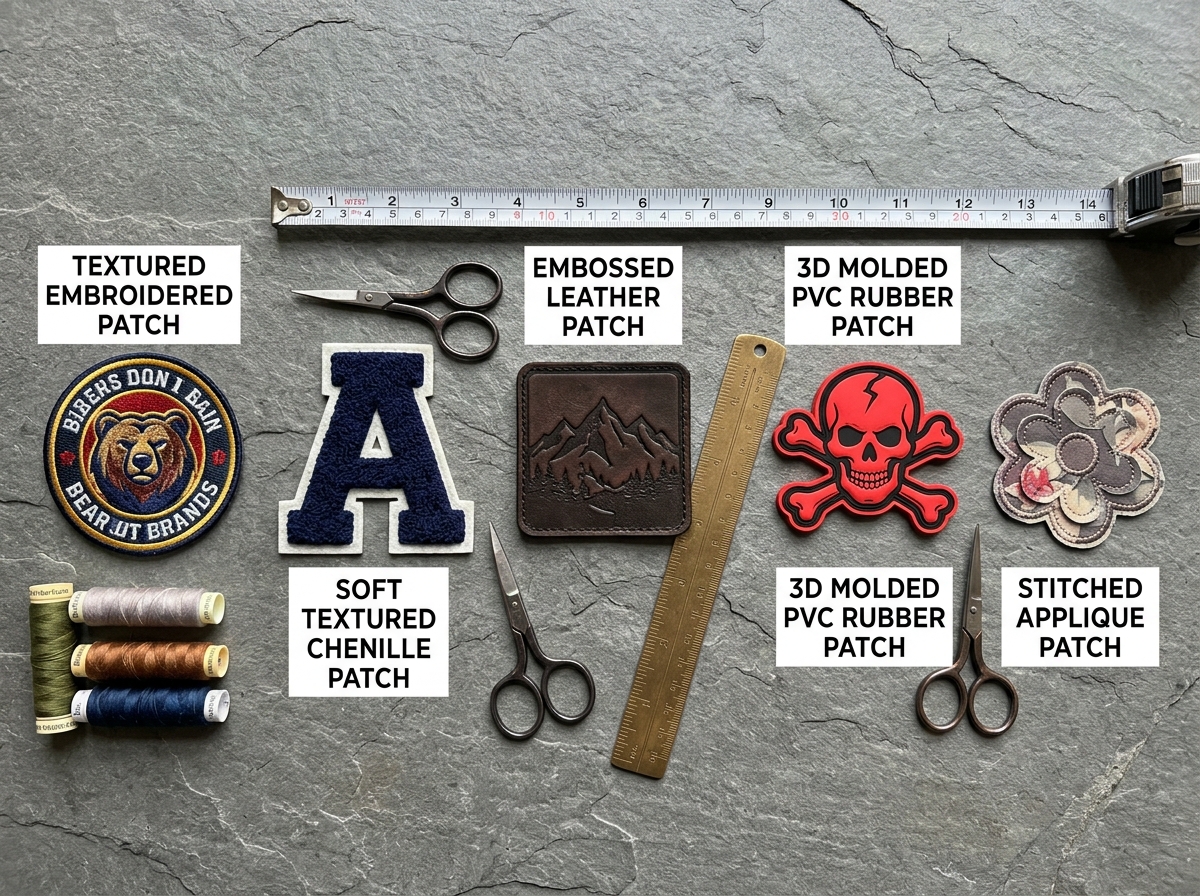
Custom embroidered patches are the most popular choice for good reason. They’re textured, durable, and versatile. They work well for uniforms, jackets, bags, and branded merchandise. The trade-off: fine details and tiny text can lose clarity.
Leather Patches
Leather patches bring a rugged, upscale feel. They’re often laser-engraved or debossed and look great on hats, jackets, and bags. Genuine leather ages naturally, while synthetic leather offers more consistency and a lower price. Leather isn’t ideal for garments that go through heavy commercial washing.
PVC Rubber Patches
PVC rubber patches are waterproof, flexible, and very durable. They handle rain, mud, and sweat, which makes them popular for outdoor gear, tactical wear, and maritime use. They also hold sharp detail and bright colors. They’re heavier than embroidery and less breathable on light garments.
3D Puff Patches
3D puff patches use a foam layer under the stitching to create a raised, bold look. They stand out on caps and streetwear. Simple, chunky designs work best. Fine lines and small lettering don’t puff well.
Applique Patches
Applique patches layer fabric pieces under stitched outlines. This reduces stitch count on large designs, keeps the patch lighter, and creates a classic varsity look. They’re a smart, cost-efficient choice for large back patches and sports jackets.
Denim and Jeans Patches
Denim patches and jeans patches include waistband labels, back pocket badges, and decorative fabric patches. Leather, faux leather, and printed labels are common for brand labels. Fabric denim patches suit repairs and vintage and retro patches looks.
Hat Patches and Cap Embroidery Patches
Hat patches need to suit a curved surface. Leather, PVC, woven, and embroidered options all work. Cap embroidery patches give you the stitched look of direct embroidery with easier application and cleaner edges. Size and weight matter here, since a heavy patch can distort a cap’s front panel.
Workwear Patches
Workwear patches must survive abrasion, grease, sun, and industrial laundering. Sewn-on embroidered patches with merrowed borders and polyester thread are a common, proven combination. Specialized jobs may need flame-resistant or reflective options, which we’ll cover below.
Matching Patches to Your Industry
Different uses put different demands on a patch. Here’s how to think about the right fit.
Trades, Construction, and Service Businesses
Construction worker patches, HVAC companies patches, welding company bullion patches , USA, and automotive repair shop logo patches USA face heat, dirt, and constant friction. Choose dense embroidery, sewn backing, and strong borders. Workwear clothing patches for these fields should be tested against your laundry process before you order in bulk.
Healthcare and Corporate Settings
Hospital and clinics patches need to look clean and professional while handling frequent, high-temperature washing. Medical uniform patch suppliers should offer colorfast thread and backings that don’t loosen over time. For corporate office patches, color accuracy and a polished finish matter most, since these often appear on polos and jackets worn in front of clients.
Aviation and Transportation
Airline embroidered logo patches, USA, pilot uniform patches, USA, and airport security uniform patches USA must look sharp and consistent across many employees. Precise color matching and repeatable production matter here. Railway uniform patches, USA, and bus company uniform patches USA need the same consistency, plus durability for daily wear. Shipping crew uniform patches and yacht club logo patches The USA benefits from PVC or tightly stitched embroidery that resists salt air and moisture.
Energy, Industrial, and Heavy Industry
Oil and gas company logo patches USA, mining company chenille patches in USA, and energy and utility company patches USA often go on flame-resistant (FR) clothing. This is critical: a standard patch can compromise an FR garment’s protection. Ask your vendor for FR-rated materials designed for use with FR apparel, and confirm compatibility with your safety program and garment manufacturer.
Sportswear and Teams
Sportswear patches need to be lightweight and flexible so they don’t restrict movement. Applique, woven patches, and thin embroidered patches work well. For team uniforms, consistency across sizes and reorders is key.
Events and Celebrations
Event patches have different priorities. Durability still matters, but design, color, and fast turnaround often matter more.
- Custom music festival patches USA: Bold colors and unique shapes make great keepsakes.
- Comic convention embroidered patches USA and gaming convention logo patches USA: Fans love detailed artwork, so PVC or high-detail embroidery shines.
- Charity run and marathon patches USA: Iron-on or sew-on patches make affordable finisher rewards.
- Wedding and family reunion patches USA: Small runs with personal touches, often embroidered or leather.
- Commemorative and anniversary patches USA: Premium materials and careful detail honor the milestone.
For events, confirm the delivery date in writing. A late patch for a one-day event has no value.
How to Choose a Reliable US Patch Vendor
Know Which Type of Vendor You Need
- Iconic Stitches custom patch manufacturer: Produces patches to your specs under your brand. Good for apparel brands and resellers.
- Industrial patch manufacturer or industrial patch suppliers: Focus on large volumes and heavy-duty specs for workwear and uniforms.
- Contract patch manufacturer: Handles production on an ongoing contract, often with set pricing and schedules.
- Patch supplier for global brands: Manages large, repeat orders with strict consistency and documentation.
Many companies with custom patches use a mix. A brand might work with an OEM partner for retail merchandise and an industrial supplier for staff uniforms.
Red Flags to Watch For
Walk away or ask hard questions if a vendor:
- Won’t provide a digital proof before production.
- Refuses to send physical samples or charges unreasonable fees for them.
- Gives vague answers about materials, thread type, or backing.
- Quotes a price far below every competitor without explaining why.
- Can’t share real photos of past work.
- Has no clear return, remake, or defect policy.
- Responds slowly or inconsistently before you’ve even paid.
How to Evaluate a Sample
Order a sample before any large order. When it arrives:
- Compare colors to your brand reference in natural daylight.
- Inspect stitching, borders, and small details with a magnifier.
- Test the backing on your actual garment.
- Wash and wear test it under real conditions.
- Measure it to confirm the size is accurate.
Keep the approved sample. It becomes your quality standard for every future order.
Minimum Order Quantities (MOQs)
MOQs vary widely by vendor and patch type. Some offer small runs for events and startups, while industrial suppliers may require larger volumes. Unit price usually drops as quantity rises. Ask for price breaks at several quantity levels so you can plan reorders.
Production Timelines
Ask for a written timeline that covers proof approval, sample production, full production, and shipping. Rush options often exist, but confirm the cost and whether quality checks still happen. Build in extra time for reorders and peak seasons.
Compliance and Safety
Depending on your use, ask about:
- FR compatibility for patches on flame-resistant workwear.
- Reflective or high-visibility elements for road, rail, and utility crews.
- Children’s product safety requirements if patches go on kids’ apparel.
- State chemical disclosure rules, such as California’s Proposition 65.
- Domestic sourcing rules for some government and military contracts.
A patch safety solution provider or experienced uniform vendor should explain these clearly and provide documentation on request.
Communication Standards
Good vendors are easy to work with. Expect:
- A dedicated contact person for your order.
- Clear, written quotes with all costs listed.
- Proactive updates if anything changes.
- Honest advice when your design won’t translate well to a certain patch type.
When USA-Made Patches Are the Best Fit
USA-made patches aren’t always the cheapest option, but they can be the smartest one in certain situations:
- Tight deadlines: Domestic production often means shorter shipping times and fewer customs delays.
- Government or military work: Some contracts require domestic sourcing.
- Brand values: “Made in USA” matters to many customers and employees.
- Close collaboration: Same time zones make fast changes and approvals easier.
- Consistent reorders: Domestic partners can make it simpler to keep uniform patches matching year after year.
Overseas production can make sense for very large, non-urgent orders with flexible timelines. Many US vendors offer both options, so ask which fits your project best.
Conclusion
High-quality custom patches protect your brand’s image every day they’re worn. The best results come from matching the right patch type to your use, inspecting materials and construction closely, testing samples under real conditions, and partnering with a vendor who communicates openly and delivers on time. Whether you’re outfitting a hospital, a construction crew, an airline, or a festival crowd, a little diligence upfront saves money and frustration later.